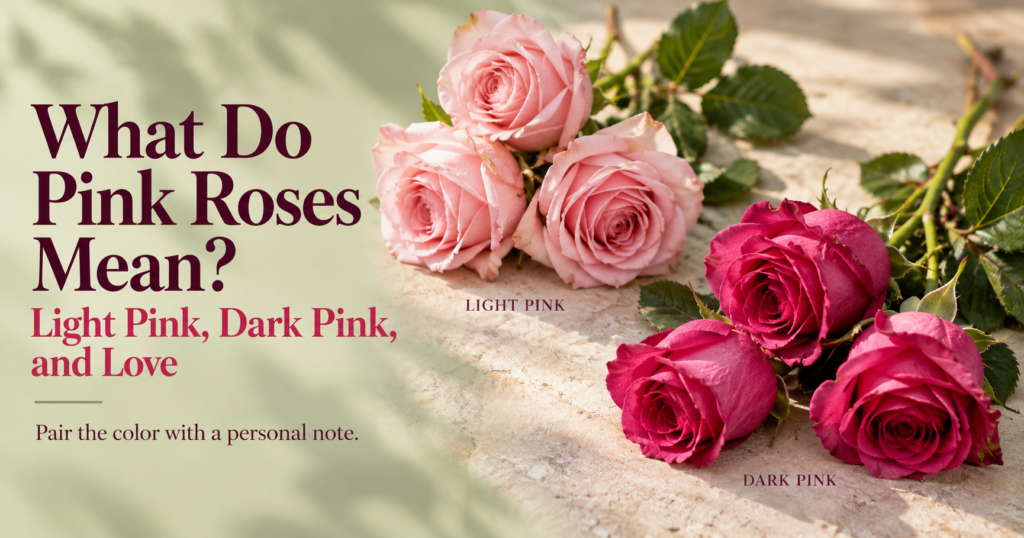
Pink roses commonly mean admiration, gratitude, joy, and affection. Light pink is often associated with gentleness, while dark pink is commonly used to express appreciation or thanks.
They can be romantic, too. Pink roses don’t automatically mean friendship, and they aren’t a smaller version of love.
That last part matters to me. If someone chooses your favorite pink flowers instead of red ones, I wouldn’t start wondering whether they love you slightly less this week.
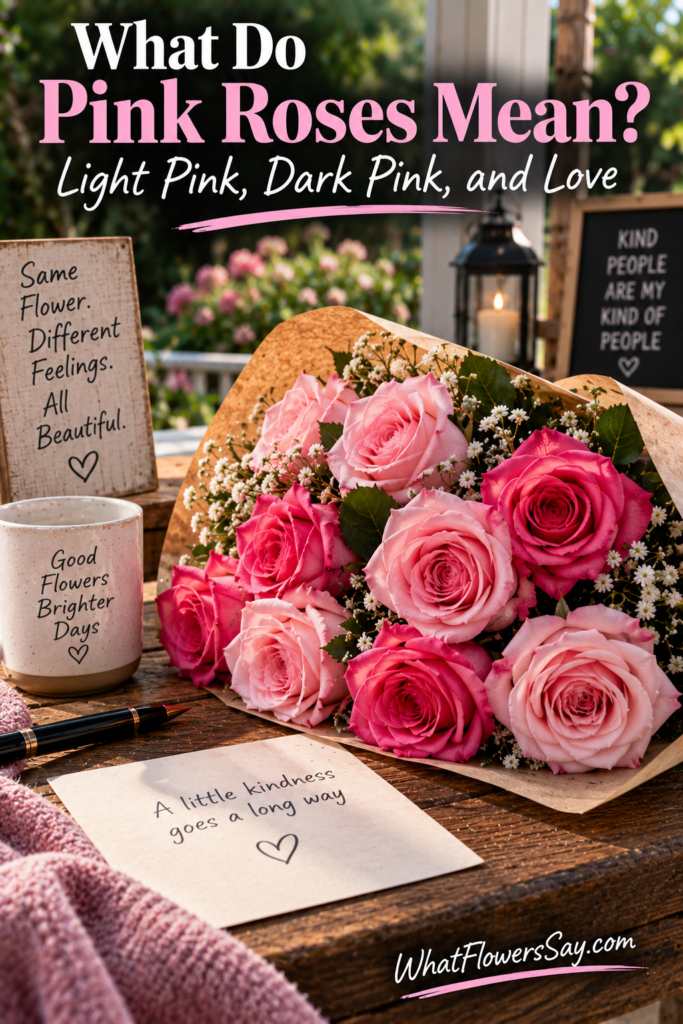
There’s plenty of room in a pink bouquet for “I love you,” “I’m proud of you,” or “thank you for being there.” The shade can help you choose the look and feeling of the gift. Your relationship and the card give it a clearer meaning.
What Pink Roses Usually Mean
Modern florist guides connect pink roses with admiration and appreciation. Interflora also describes them as suitable for affection between friends and family members. Those are common gift associations, rather than rules everyone follows.
I like pink as an option when I want a gift to feel warm and personal.
Maybe you admire someone’s work. Maybe you’re thankful for their help. Maybe you love them and know they’d enjoy seeing a vase of pink roses on the table.
Those are all good reasons.
Admiration
Admiration doesn’t have to mean putting someone on a pedestal.
Sometimes it means, “I saw how you handled that, and I respect you for it.”
A friend goes back to school while working. Your sister finishes a project she almost gave up on. Someone you care about makes a difficult decision and follows through.
I’d consider pink roses with a note that recognizes the effort:
“I know this wasn’t easy. I’m proud of the way you kept going.”
That feels more personal than calling someone amazing without saying why.
Gratitude
Gratitude is one of the most useful associations because there are so many people who deserve a proper thank-you.
Not an expensive thank-you. A thoughtful one.
For me, the important question is: What did this person do that I want them to know mattered?
If you can answer that, you already have the beginning of your card.
Affection
Affection gives pink roses room to work in different relationships.
I’d consider them for a parent, close friend, spouse, or someone I’m dating. The message would change, of course.
“You make our family feel loved” and “I’m looking forward to another date with you” belong to very different relationships, even if the flowers look exactly the same.
Light Pink vs. Dark Pink Roses
This is the main shade difference worth knowing.
FTD describes dark pink roses as a way to express thanks and pale pink as a gentler choice, including for sympathetic occasions. These are modern gifting conventions, not an exact system for measuring someone’s feelings.
I’d use that distinction as a starting point, then choose what suits the recipient.
Light Pink Roses
Light pink would be my first consideration for someone who loves soft colors.
For a supportive gift, I like the idea of a small, gentle-looking arrangement with a note that asks nothing from the person receiving it.
“Thinking of you today. You don’t need to write back.”
That can be especially kind when someone is overwhelmed. They get to enjoy the gesture without adding “send a thoughtful reply” to an already crowded day.
Light pink could also make a lovely romantic gift. I wouldn’t reserve it for delicate occasions or assume it says something less affectionate than a darker shade.
Dark Pink Roses
Dark pink is a common thank-you choice, and I’d consider it when appreciation is the main reason for sending flowers.
My note might say:
“You gave so much of your time to help me. I wanted you to know how grateful I am.”
If the person prefers pale flowers, though, I’d choose pale flowers. Giving them a color they enjoy matters more to me than getting the shade symbolism perfectly right.
A thank-you shouldn’t come with homework about why you selected hot pink.
What About Medium Pink or Mixed Pink Shades?
I wouldn’t invent a separate message for every shade between blush and deep pink.
A mixed pink bouquet can simply be a beautiful pink bouquet.
If the arrangement looks right for the person and the card says what you mean, you’ve done the important part. Nobody needs to count the pale flowers and compare them with the darker ones.
Are Pink Roses Romantic?
Yes, pink roses can be romantic. They can also express care in a friendship or family relationship.
Interflora includes love among their associations while also describing uses for friends and relatives. That makes the relationship important when interpreting the gift.
I wouldn’t use the color alone to decide how serious someone’s feelings are.
For a romantic partner, a pink bouquet with an affectionate note can be very clear:
“I love you, and I wanted to give you something just because.”
That doesn’t need red roses to make sense.
Pink Roses Early in Dating
A pink bouquet is an option I’d consider when the interest is mutual and flowers would feel welcome.
I’d keep the message close to where the relationship actually is:
“I’ve really enjoyed getting to know you. Looking forward to seeing you again.”
There’s no need to borrow a huge declaration from a greeting card when a simple sentence sounds more like you.
I’d also think about how the gift will arrive. A small bouquet given privately might be sweet. A surprise delivery at work could be uncomfortable for someone who likes keeping their personal life private.
The most thoughtful choice depends on what they enjoy.
Pink Roses for Your Spouse
I don’t think romance needs to look the same every time.
If your spouse loves pink, choose pink. If they like small arrangements, you don’t have to buy something that occupies half the kitchen.
I’d pair the flowers with a detail from your life together:
“I love how you still find ways to make me laugh on the long days.”
Or:
“I know we’ve both been tired. I’m glad we’re doing this together.”
Those words carry affection because they belong to your relationship.
If Someone Gave You Pink Roses
My first thought would be to read the card before searching for a hidden meaning.
Did they thank you? Mention a birthday? Say they miss you? Write something romantic?
That gives you more to work with than the shade.
If the card is vague and you’re curious, ask casually:
“These are so pretty. What made you choose pink?”
Maybe they remembered your favorite color. Maybe they liked the arrangement. Maybe the choice had a meaning they’d be happy to explain.
I’d leave room for their actual answer.
A bouquet is a gesture. It isn’t a reliable relationship test, and I wouldn’t let a color chart turn a nice surprise into a worry.
Pink Roses for a Thank-You
This is an occasion where I’d spend more time on the note than comparing bouquet photos.
Think about the kindness you received.
Someone stayed late to help. Checked on your family. Brought food. Took care of a problem without making you feel bad for needing them.
Name it.
“Thank you for checking in after that difficult week. It helped knowing someone was thinking of us.”
That sentence gives the flowers a reason.
If you’re choosing between pink and peach for this kind of gift, both are worth considering. Our guide to peach roses and heartfelt thank-you gifts covers the other option.
For Someone Who Doesn’t Make a Fuss
Some people are happy to help and uncomfortable being thanked in a big way.
For them, I’d keep the gift modest and the message easy:
“I know you’ll say it was nothing. It wasn’t nothing to me. Thank you.”
I like that because it acknowledges their kindness without putting them on the spot.
A small arrangement can feel more comfortable than a grand delivery, especially when the person would rather quietly enjoy it at home.
Birthdays, Mother’s Day, and Everyday Love
I’d consider pink roses for these occasions when they suit the person receiving them.
The occasion doesn’t require a particular shade. You have room to choose based on taste.
For Your Mom or Grandma
A Mother’s Day card can be short and still say something meaningful.
I’d write about a real thing you appreciate rather than trying to fit an entire lifetime into four inches of cardstock.
“Thank you for always making time to listen.”
Or:
“I love how you make everyone feel welcome.”
If your relationship is playful, let that show:
“Some pretty flowers for the person who still worries whether I’ve eaten. I have. Love you.”
Use the joke only if it sounds like the two of you. Warmth doesn’t need to be forced.
For a Friend’s Birthday
I’d choose a bouquet that looks like their taste, then let the note sound like your friendship.
“Happy birthday. I’m very glad we found each other and have been encouraging each other’s nonsense ever since.”
Or something quieter:
“I’m grateful for another year of your friendship. Hope today feels special.”
Either can be right. You know which one your friend would smile at.
For No Particular Occasion
Flowers don’t have to wait for a date on the calendar.
I’d consider a pink bouquet when someone has been on my mind and I want to do something kind.
The card can say exactly that:
“No special occasion. I was thinking of you.”
There’s something lovely about a gift that doesn’t arrive because it was expected.
Can Pink Roses Be Sympathy Flowers?
Pink roses appear in sympathy arrangements, and pale pink is commonly described as a gentle choice for those occasions.
Before sending flowers, I’d check the family’s wishes. If they ask for donations or another form of support, I’d follow that request.
When flowers are welcome, I’d think about what the recipient would appreciate. Their preferences matter more than finding a supposedly perfect grief color.
For the card, I’d avoid asking them to feel better.
“I’m so sorry for your loss. I’m thinking of you and your family.”
If you knew the person who died, an honest memory can be meaningful:
“I’ll always remember how kindly she welcomed me. I’m grateful I knew her.”
You don’t need words that make the sadness disappear. You need words that show you care.
What I’d Write With Pink Roses
These are original card messages you can use or change. Pick the one that fits your relationship, then add a personal detail if you have room.
For a Thank-You
“You made time for me when you had plenty going on yourself. I appreciate that more than you know.”
For Someone You Admire
“I’ve seen how much effort you’ve put into this. I hope you’re proud of yourself, because I am.”
For Your Partner
“I love our life together, including the ordinary evenings that don’t make it into pictures.”
For Someone You’re Dating
“You’ve given me something really nice to look forward to. Can’t wait to see you again.”
For Your Mom
“Thank you for the love you put into all the little things. I notice them, and I love you.”
For a Close Friend
“You make it easier to be myself. That’s a gift I’m grateful for.”
For Someone Having a Hard Time
“I know this has been a lot. I’m thinking of you, and I’m here.”
For a Birthday
“Some flowers for someone I’m very glad to know. Happy birthday.”
For a Playful Thank-You
“I considered writing you a very long thank-you text. These seemed more pleasant to receive.”
Choosing the Pink They’ll Actually Enjoy
Before ordering, I’d look at the person’s taste.
Do they like pale colors or bright ones? A small arrangement or something fuller? Roses by themselves or a mixed bouquet?
Those details make the choice feel personal.
If the exact shade matters, tell the florist what you mean. “Very pale blush pink” gives more direction than “pink,” and it’s worth asking whether substitutions could change the finished look.
I’d also check whether a vase is included, especially if the flowers are going to someone busy or away from home.
Then I’d make the card specific.
“You deserve these” is kind.
“I wanted to thank you for making sure I didn’t have to handle that day alone” tells them why.
That’s the part I’d want them to remember: someone noticed what they did, cared enough to say it, and chose something pretty with them in mind.
Written by the What Flowers Say Editorial Team, sharing researched flower meanings and thoughtful gift ideas.