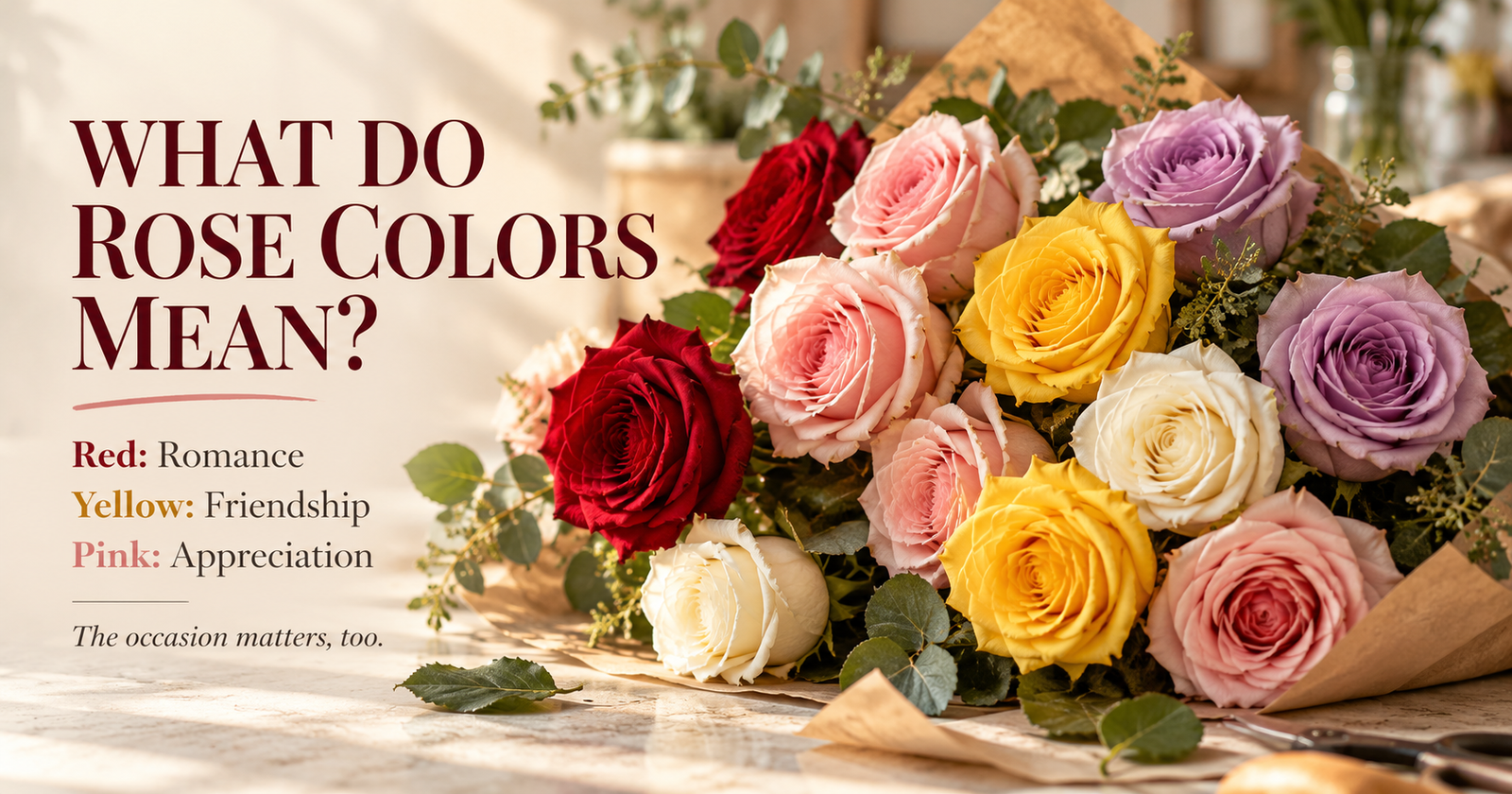
Red roses commonly represent romantic love, yellow roses friendship, pink roses appreciation, and white roses purity or remembrance. Orange roses lean toward enthusiasm and passion, while peach roses are often associated with sincere thanks. Those meanings give you a starting point, but they don’t tell the whole story.
When I’m thinking through a flower gift, I care about a more practical question: What will this bouquet say to this particular person?
A dozen red roses sent to a spouse feels different from the same bouquet sent to someone you’ve had one lunch with. White roses at a wedding and white roses beside a sympathy card can both make sense. Yellow roses don’t cancel out a romantic relationship just because a chart calls them friendship flowers.
I’d use rose meanings to help choose a thoughtful gift, then let a short, honest card make the message clear. Here’s how I’d approach the colors without turning a kind gesture into a secret code someone has to solve.
Rose Color Meanings at a Glance
| Rose color | Common association | When I’d consider it |
|---|---|---|
| Red | Romantic love and passion | An anniversary or a clear romantic gesture |
| Pink | Admiration, gratitude, and joy | Thanking someone or celebrating them |
| White | Purity, respect, and remembrance | A wedding, memorial, or thoughtful expression of support |
| Yellow | Friendship and caring | A friend’s birthday or a cheerful surprise |
| Orange | Enthusiasm and passion | Celebrating an achievement or expressing attraction |
| Peach | Sincerity and gratitude | A personal thank-you |
| Purple or lavender | Fascination and enchantment | A distinctive gift, especially for someone who loves purple |
| Blue | The impossible or unattainable | A gift with a deliberately unusual theme |
| Black | Meanings vary, including mourning and rebirth | Someone who specifically enjoys dark floral designs |
Modern florist guides broadly agree on the familiar colors, although their explanations differ. Interflora, for example, connects red with romance, pink with appreciation, yellow with friendship, and orange with enthusiasm.
If you’re choosing a bouquet right now, start with the sentence you want to write on the card. “I love you,” “thank you,” and “I’m here for you” lead to different choices more naturally than memorizing nine colors does.
Red Roses When You Want the Romance to Be Clear
Red is the color I’d choose when I want the romantic side of the gift to be obvious.
For an anniversary, I wouldn’t worry about finding a less predictable color just to be different. Familiar can be a good thing. If the point is to tell your spouse you still love them, red roses fit that message comfortably.
For a new relationship, I’d think more carefully about the size of the gesture. One rose with a thoughtful note might feel sweet. A large bouquet delivered to someone’s workplace could create more attention than they wanted.
The question isn’t whether red roses are allowed early in dating. It’s whether the gift matches the relationship you actually have.
My card would be simple:
“You’re still the person I want beside me at the end of the day.”
That says more than a complicated explanation about the exact shade of red.
Pink Roses When I Want to Show Appreciation
Pink roses are often associated with gratitude and admiration. Darker pink is commonly presented as a thank-you color, while pale pink carries gentler associations. These shade distinctions appear in modern gifting guides, including FTD’s explanation of rose colors.
I’d reach for pink when the message is affectionate but doesn’t need to be a declaration of romantic love.
Think of a sister who helped during a stressful week, a parent celebrating a birthday, or a friend who finally finished something difficult. In those situations, I’d rather write about what they did than make the card explain the flowers.
For someone who showed up when you needed help:
“You made a hard week easier. I wanted you to know I noticed.”
For a celebration:
“I know how much work went into this. I’m proud of you.”
Pink would also be a reasonable romantic choice if it’s the recipient’s favorite color. I wouldn’t set aside someone’s actual taste because a chart assigns red the stronger love meaning.
White Roses Can Fit Both Happy and Sad Occasions
White roses are commonly linked with purity and innocence, but modern gift meanings also include respect and remembrance. That helps explain their use in both wedding and sympathy arrangements.
I don’t see those occasions as a contradiction. The setting changes the message.
At a wedding, I’d look at white roses as part of the couple’s chosen style and the meaning they want their flowers to carry. Beside a sympathy card, I’d see them as a quiet way to acknowledge someone’s loss.
For a person who is grieving, I’d keep the wording gentle:
“I’m thinking of you and remembering how much they meant to you.”
I wouldn’t write that everything happens for a reason or try to explain away the sadness. Flowers don’t need to solve grief to be a caring gift.
For a wedding, the note would be completely different:
“Wishing you a home full of kindness, laughter, and ordinary days you’re glad to share.”
Same rose color. Different people, different occasion, different message.
Yellow Roses When the Gift Is About Friendship
Yellow roses are widely associated with friendship and caring.
They’d be high on my list for a friend’s birthday, a welcome-home gift, or a small surprise for someone who could use a cheerful moment.
But I wouldn’t treat yellow roses as an announcement that romance is off the table. If your spouse loves yellow, choosing that color shows you paid attention. A personal preference matters more to me than following a chart perfectly.
If you receive yellow roses from someone you like, the bouquet alone won’t tell you whether they feel the same way. They may know the friendship association. They may simply like the flowers.
For a friendship gift, I’d write:
“No occasion. I’m just glad you’re in my life.”
For a romantic partner who loves yellow:
“I picked your favorite color because this was supposed to make you smile.”
Neither message requires the recipient to look anything up.
Orange Roses for Excitement, Celebration, or Attraction
Orange roses commonly carry associations with enthusiasm and passion.
I like orange as a possibility when a gift should feel energetic. A new job, graduation, or long-awaited achievement gives that energy a clear purpose.
For someone who finally reached a goal:
“You kept going when it would have been easier to quit. This deserves celebrating.”
Orange can also fit a romantic gift, but I’d let the card establish that intention. The color alone doesn’t make a reliable distinction between “I’m proud of you” and “I’m attracted to you.”
For someone you’re dating:
“I’ve really enjoyed getting to know you. I’d like to keep doing that.”
That feels more natural to me than borrowing an elaborate message about burning desire, especially when the relationship is still new.
Peach Roses for a Thank-You That Feels Personal
Peach roses are associated with sincerity and gratitude in modern florist explanations, including Interrose’s guide.
This is a color I’d consider when someone helped in a way that deserves more than a quick text.
Maybe they brought meals during a difficult stretch, watched the kids, helped with a move, or checked in without making you ask. The best part of that gift would be naming their kindness.
“You helped without making me feel like a burden. Thank you for that.”
Or:
“You gave your time when you already had plenty going on. I haven’t forgotten.”
I’d choose between peach and pink mostly by the recipient’s taste and the bouquet itself. Both can support a thoughtful thank-you. There’s no need to find an exact emotional difference between two flowers that might even look similar under different lighting.
Purple and Lavender Roses Leave More Room for Interpretation
Purple and lavender roses are often described using words such as fascination and enchantment. Some florist guides attach “love at first sight” to lavender or purple roses, although their treatment of the shades varies.
I’d handle that meaning lightly.
They can make a beautiful romantic gift, but I wouldn’t assume that receiving them means someone fell in love immediately. Nor would I avoid giving them to a friend who loves purple.
My first reason for choosing them would be that they suit the person. The symbolism could be an extra detail if it feels right.
For a birthday:
“These looked like something you’d choose for yourself, so I chose them for you.”
For a romantic gift:
“I wanted to give you something a little different, because getting to know you has been.”
You don’t have to use the phrase “love at first sight” just because it appears in a flower guide.
Blue and Black Roses Need a Little More Context
These colors draw attention, but I’d be more careful about assuming their meaning will be understood.
Blue Roses and the Idea of Something Unattainable
Blue roses have been associated with the impossible or unattainable. Their unusual color has a real botanical story behind it: roses do not naturally produce the blue pigment delphinidin, and Suntory used biotechnology to develop roses that contain it.
If I were buying blue roses, I’d ask the seller how that particular color was produced rather than assume the product photo tells the whole story.
As a gift, I’d choose them for someone who enjoys unusual flowers or has specifically mentioned wanting them. I wouldn’t expect the color to communicate a clear romantic message on its own.
A note could make the choice personal:
“You always notice the unusual things. These made me think of you.”
Black Roses Don’t Have One Fixed Message
Black-rose meanings vary considerably. Interrose lists associations ranging from mourning to rebirth and devotion, which is a good reason to avoid treating them as a single, settled message.
I’d reserve this choice for someone whose taste I know well.
If a friend loves dark floral designs, a dramatic bouquet could be exactly right. If I’m sending flowers to a grieving family and don’t know their preferences, I’d choose something more familiar.
I’d also ask what I’m actually buying: a very dark flower, a dyed bloom, a preserved rose, or an artificial arrangement. The product details matter when a particular appearance is the whole reason for the purchase.
Why Rose Meaning Charts Don’t Always Agree
The language of flowers has a history, but that history doesn’t give us one official dictionary.
The Royal Horticultural Society explains that floral messages became fashionable in Britain and America during the 1800s. Writers produced their own versions of the meanings, drawing on different sources and preferences. The resulting dictionaries could be difficult to reconcile.
One particularly useful example comes from Smithsonian Gardens: it describes a white rose carrying a message about remaining single in one 1852 book and a message of worthiness in an 1856 book. Even historical sources could disagree.
That’s why I separate common modern gift associations from a meaning recorded in a particular historical book.
If you’re choosing flowers today, a modern association can help. If you’re researching a Victorian story, painting, or letter, the specific source and period matter much more.
The RHS history of the language of flowers is a helpful place to understand how those different floral dictionaries developed.
How I’d Choose Roses When the Situation Is Complicated
The easy occasions aren’t usually the ones that make people hesitate. It’s the new relationship, the apology, or the gift that might be misread.
For Someone I’ve Just Started Dating
I’d keep the gift in proportion to the relationship and consider whether they enjoy receiving flowers.
A small pink or orange bouquet would be an option I’d consider. Red could work too if the romantic interest is already clear. I wouldn’t choose based on a claim that one color guarantees the perfect level of commitment.
The note could say:
“I had a good time with you. I’m looking forward to the next one.”
For an Apology
I wouldn’t search for a rose color that supposedly means the apology has been accepted. Acceptance belongs to the other person.
If flowers seem welcome, I’d choose a color they like and put the actual apology in the card:
“I’m sorry I dismissed what you were saying. I should have listened, and I understand why that hurt.”
That’s a more useful message than “sorry for everything,” and it doesn’t ask the bouquet to do the work of taking responsibility.
For a Coworker or Professional Thank-You
I’d think about workplace expectations, how well we know each other, and whether a flower gift would feel comfortable.
Pink, peach, or yellow would be colors I’d consider, with a note tied directly to the reason:
“Thank you for helping me get this across the finish line.”
A modest gift and clear wording would matter more to me than finding the supposedly perfect nonromantic rose.
For Someone Having a Hard Week
I’d choose their favorite color if I know it. Otherwise, I’d consider a gentle pink or peach arrangement and write something that doesn’t require a cheerful response.
“You don’t have to answer this. I just wanted you to know I’m thinking of you.”
Sometimes that permission is the kindest part of the gift.
Mixed Rose Colors Don’t Need an Exact Translation
I’d happily choose a mixed bouquet when several colors look right together or reflect someone’s taste.
Pink and peach could support a thank-you. Yellow and orange would be a combination I’d consider for a celebration. Red and pink could suit an affectionate romantic gift.
Those are my suggested combinations, not fixed formulas. Adding three yellow roses to six pink ones doesn’t create a sentence with one universally accepted meaning.
If I want the colors to mean something particular, I’d explain it briefly:
“I chose the yellow because it’s your favorite and the pink because I wanted to say thank you.”
That makes the choice meaningful without pretending the recipient should already know the explanation.
Questions I’d Ask Before Sending Roses
Does receiving roses mean someone is in love with me?
No bouquet can establish that by itself. Red roses have a familiar romantic association, but the relationship, occasion, card, and sender’s behavior give you more information than the color alone.
Can I give yellow roses to my spouse?
Yes. I wouldn’t let a friendship association rule out a color your spouse loves. A warm, personal note makes your intention clear.
Which rose color would I choose for a thank-you?
I’d consider pink or peach, then choose the arrangement that best suits the recipient. I’d spend at least as much thought on naming what I’m grateful for.
Are white roses only for funerals?
No. Modern gift associations include both purity and remembrance, and white roses are used for happy occasions as well as expressions of sympathy.
Do I need to explain the rose color on the card?
Only if that explanation adds something personal. “I picked your favorite color” can be lovely. A long lesson about flower symbolism usually isn’t necessary.
What I’d Write Before I Ordered the Flowers
Before choosing a bouquet, I’d finish this sentence: “I’m sending these because…”
If the answer is “because I love you,” I’d consider red or the person’s favorite color. If it’s “because you helped me,” I’d consider pink or peach. If it’s “because I miss my friend,” yellow would be an option.
Then I’d put the real reason on the card.
“You made room for me when I needed someone.”
“I’m proud of the work you did to get here.”
“I still look forward to seeing you walk through the door.”
Those details make a flower gift feel personal. The roses can carry a familiar association, but your own words tell the recipient why you chose them.
Written by the What Flowers Say Editorial Team, sharing researched flower meanings and thoughtful ways to use them.